Growth is the ultimate goal for most entrepreneurs, but there is a profound difference between growing your revenue and scaling your business. Growth means you are adding resources at the same rate you are adding revenue. Scaling means you are adding revenue at an exponential rate while your operational costs increase only incrementally. This comprehensive guide outlines the ten crucial steps you must take across legal, physical, and operational sectors before you trigger your next major expansion phase.
Phase 1: Securing Your Intellectual and Physical Assets

1. Audit and Lock Down Your Brand Assets
When you operate regionally or on a modest scale, your exposure to intellectual property conflicts is relatively low. However, expansion draws immediate attention. If you scale your marketing, distribution, or digital presence without airtight legal protections, you risk receiving a cease-and-desist letter that could force an incredibly expensive corporate rebranding campaign right when your capital is tied up in inventory.
Before investing in rapid market expansion, your first step should be to transition from basic common-law trademark protections to comprehensive federal or international registrations. This requires deep due diligence. You must engage a qualified trademark attorney who can evaluate your entire portfolio of logos, product names, slogans, and proprietary software titles. This legal expert will look beyond simple identical matches to ensure your branding does not cause a likelihood of confusion with existing registered marks in your expanded target markets.
Simultaneously, if your expansion involves acquiring new corporate real estate, manufacturing plants, or warehousing facilities, you cannot rely on basic commercial real estate listings. You must execute an exhaustive industrial property search to uncover any underlying zoning restrictions, environmental liabilities, or easement conflicts that could halt your operations. Ensuring your physical expansion plans align with municipal regulations protects your capital from being trapped in unusable real estate.
To execute this phase cleanly, consider the following action items:
-
Create a centralized registry of every brand asset, domain name, social media handle, and proprietary design currently used by your business.
-
Budget for ongoing brand monitoring services that scan global registries to catch and challenge potential infringers before they dilute your market share.
-
Verify that all independent contractors or agencies who previously worked on your branding have formally signed intellectual property assignment agreements, guaranteeing that your company owns the assets outright.
2. Fortify Your Digital and Physical Data Security
Scaling up means processing vastly larger amounts of customer data, financial records, proprietary corporate strategies, and employee files. This increased volume inevitably transforms your business into a high-value target for cybercriminals and corporate espionage. Furthermore, regulatory bodies levy crippling fines on expanding companies that fail to comply with data privacy laws such as GDPR or CCPA.
While digital security often takes center stage, physical document security is equally critical. As administrative workloads increase, physical paperwork can pile up, creating severe vulnerabilities. Your organization must establish an unyielding protocol for the destruction of obsolete physical documentation. Working with a certified document shredding provider guarantees that sensitive HR files, outdated financial statements, and proprietary product schematics are permanently destroyed before they can fall into the wrong hands.
On the digital front, your scaling blueprint must include the following security measures:
-
Transition your network architecture to a strict Zero Trust model, requiring continuous verification for every user and device attempting to access corporate data.
-
Enforce mandatory, recurring security awareness training for all employees, specifically focusing on sophisticated phishing and social engineering tactics that target expanding firms.
-
Implement automated data classification systems that flag, encrypt, and restrict the movement of highly sensitive customer or corporate information across your network.
Phase 2: Upgrading Facilities and Utilities for Higher Volume
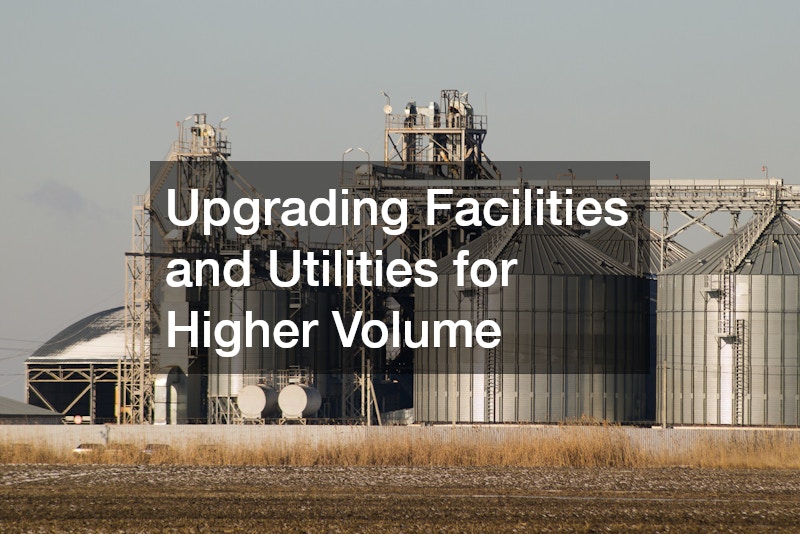
3. Stress-Test Your Facility’s Utility Infrastructure
A major bottleneck that catches expanding businesses off guard is the physical capacity of their current facilities. Increasing production quotas, adding secondary shifts, or doubling your administrative headcount places an immediate, compounding strain on your building’s core utility infrastructure.
Commercial plumbing and waste management systems are highly vulnerable to sudden increases in usage volume. Before you scale up your workforce or install fluid-dependent machinery, you must have a licensed commercial plumber conduct a full diagnostic review of your property. This involves deploying mainline camera inspections to identify hidden line degradation, cracks, or root intrusions that could trigger a catastrophic backup when usage spikes.
To prepare your facility’s wet infrastructure for high-volume operations, prioritize these steps:
-
Calculate your projected peak-load water and waste demands based on your ultimate scaling targets, rather than your current average consumption.
-
Install commercial-grade backflow preventers and smart water-metering systems that can instantly detect micro-leaks and isolate line breaks before they flood inventory areas.
-
Upgrade bathroom facilities with high-efficiency, heavy-duty fixtures designed to withstand continuous, multi-shift employee usage without requiring frequent maintenance interventions.
4. Optimize and Scale Your High-Demand Energy Systems
If your expansion involves heavy machinery, fleet operations, precision heating, or independent standby power systems, grid electricity or standard municipal natural gas lines may not offer the reliability or British Thermal Unit capacity you require. Scaling up means safeguarding your business against regional energy blackouts and volatile utility pricing.
For many industrial and large-scale commercial operations, integrating an independent fuel supply is the most practical way to power expanded fleets, heavy forklifts, or processing ovens. Establishing a relationship with a reliable industrial propane service allows you to secure bulk fuel storage infrastructure directly on your property. This guarantees that your manufacturing lines or delivery networks remain fully operational even if the local utility grid experiences a prolonged failure.
When re-engineering your operational energy matrix, you should implement the following protocols:
-
Conduct a comprehensive energy audit to determine whether a centralized bulk fuel system offers lower per-unit operating costs than your current utility mix.
-
Install smart telemetry systems on all bulk fuel storage tanks, providing real-time data to your fuel supplier so deliveries are automatically scheduled before levels drop below critical thresholds.
-
Verify that all on-site energy storage solutions comply fully with local environmental protection regulations and OSHA safety buffer zones to avoid costly compliance penalties.
5. Overhaul Fire Safety and Risk Mitigation Protocols
Expanding your physical footprint, modifying your building layout, or significantly increasing your warehouse inventory densities completely changes your facility’s hazard classification. If your fire suppression capabilities do not evolve alongside your operational scale, you run the risk of violating local municipal codes, facing forced closures, or completely voiding your commercial property insurance coverage.
Your existing fire protection infrastructure was likely engineered to protect a specific arrangement of space and a specific volume of materials. When you scale, you must consult with professional fire sprinkler contractors to re-evaluate and re-engineer your suppression networks. If you are moving toward high-piled storage or automated racking systems, your existing ceiling-level sprinklers will no longer be sufficient to penetrate a fire deep within the inventory stacks.
To ensure your expanding facility remains safe and fully insurable, you must execute the following measures:
-
Request a formal hydraulic demand calculation from your fire safety partners to confirm your building’s main water connection can deliver the pressure required for expanded suppression systems.
-
Transition your warehousing zones to early-suppression, fast-response systems if your scaling plans include vertical storage configurations exceeding twelve feet.
-
Update your facility’s emergency evacuation maps, install additional illuminated exit signage, and conduct comprehensive safety drills tailored to your expanded layout and increased staff count.
Phase 3: Optimizing the Supply Chain and Production Pipeline
6. Transition from Local Workshops to Tier-1 Manufacturing
Small-scale businesses often rely on local boutique workshops, manual assembly lines, or hybrid in-house production methods. While this localized approach provides exceptional quality control during the startup phase, it becomes a massive liability when you need to scale. Manual processes simply cannot keep pace with exponential demand, leading to catastrophic backlogs, erratic lead times, and erratic product quality.
To scale successfully, you must transition your production pipeline to institutional-grade partners. Engaging established manufacturing contractors allows you to leverage advanced automated production lines, rigid quality frameworks, and economies of scale that are impossible to replicate in-house without millions of dollars in capital expenditure. These Tier-1 partners possess the capacity to absorb sudden spikes in your order volume without blinking.
When vetting and onboarding mass-production partners, embed these requirements into your strategic plan:
-
Execute legally binding Service Level Agreements that clearly define maximum permissible lead times, strict defect thresholds, and severe financial penalties for unexcused production delays.
-
Demand comprehensive transparency regarding their raw material supply chains to ensure your business is not indirectly exposed to geopolitical disruptions or unethical sourcing scandals.
-
Implement a multi-source production strategy by onboarding a primary and a secondary production partner, ensuring you are never vulnerable to a single point of failure.
7. Re-engineer Custom Component Sourcing and Tooling
If your product line relies on proprietary structural frames, custom enclosures, specialized brackets, or intricate mechanical components, your supply chain is only as strong as your foundational fabrication partner. Relying on standard job shops that utilize manual cutting and welding methods will severely limit your ability to scale.
To achieve the component consistency and cost reductions required for high-volume distribution, you must partner with an advanced metal fabrication company that utilizes automated CNC laser cutting, robotic welding, and progressive stamping dies. This transition requires a significant upfront investment in dedicated tooling and molds, but it drives your per-unit production costs down drastically while ensuring that unit number one hundred thousand is entirely identical to unit number one.
To successfully optimize your component fabrication lifecycle, focus on these tactical actions:
-
Engage in a rigorous Design for Manufacturability review with your engineers and fabrication partners to simplify component geometries, reduce weld lengths, and minimize material scrap rates.
-
Secure full ownership rights over all custom tooling, dies, and molds created for your products, allowing you to move production to an alternative facility if your primary fabricator fails to perform.
-
Negotiate long-term raw material indexing agreements with your fabricator to insulate your business from sudden, volatile swings in global steel, aluminum, or copper pricing.
Phase 4: Modernizing Operations, Logistics, and Quality Control
8. Automate Heavy Material Handling and Logistics
As your operational volume scales upward, the sheer physical mass of raw materials arriving at your facility and finished goods departing from it increases exponentially. Attempting to manage this massive physical influx with manual labor or standard, low-capacity warehouse equipment introduces severe operational friction, high injury rates, and costly logistical bottlenecks.
Your scaling blueprint must address how heavy materials flow through your ecosystem. Integrating specialized heavy equipment lifting solutions—such as automated overhead gantry cranes, custom rigging configurations, or high-capacity motorized hoists—is essential to maintaining a fluid, high-velocity floor environment. These systems maximize your vertical spatial utilization and drastically reduce the cycle time required to unload raw materials or stage outgoing freight shipments.
To build a high-efficiency logistics engine, incorporate these infrastructure practices:
-
Conduct a structural engineering audit of your facility’s concrete floor slab and overhead support beams to ensure they can safely support the static and dynamic loads of heavy lifting machinery.
-
Establish dedicated, clearly painted transit corridors that completely isolate automated lifting equipment and heavy forklifts from pedestrian walkways and administrative zones.
-
Implement a strict, software-tracked preventative maintenance schedule for all rigging and lifting mechanisms, ensuring full compliance with OSHA standards and eliminating unexpected equipment downtime.
9. Implement Real-Time, Data-Driven Quality Control
When you produce a few hundred items a month, a manual end-of-line inspection is perfectly adequate for catching defects. When you scale your operations to thousands of units per week, waiting until the final packaging stage to check for errors is an operational disaster. If a machine calibration drifts out of tolerance at the beginning of a shift, you could easily produce thousands of defective units before anyone notices, wiping out your entire profit margin for the quarter.
To scale without sacrificing your reputation, you must build quality assurance directly into the production process itself. Partnering with an expert process monitoring company allows you to integrate advanced Internet of Things sensors, automated vision inspection cameras, and statistical process control software directly into your active assembly lines. This infrastructure tracks critical metrics—such as thermal profiles, mechanical tolerances, and cycle pressures—in real time, allowing you to catch and correct deviations instantly.
To construct an airtight, scalable quality framework, deploy the following initiatives:
-
Configure automated alarm thresholds within your assembly line software that instantly halt production or divert components if a critical metric drifts outside of acceptable tolerances.
-
Empower your floor technicians with real-time data dashboards, giving them the exact insights needed to make proactive machine adjustments before defective products are generated.
-
Utilize the historical data captured by your monitoring systems to transition from reactive machine repair protocols to highly predictable, condition-based maintenance schedules.
By taking the time to systematically execute these foundational upgrades before you launch your expansion initiatives, you build an organization capable of absorbing massive market demand. True enterprise value is built by ensuring your legal protections are bulletproof, your facilities are structurally optimized, your supply chain is resilient, and your quality controls are automated. Step back, audit your infrastructure against these critical pillars, fortify your operational core, and build a launchpad that can confidently sustain your business’s long-term success.